

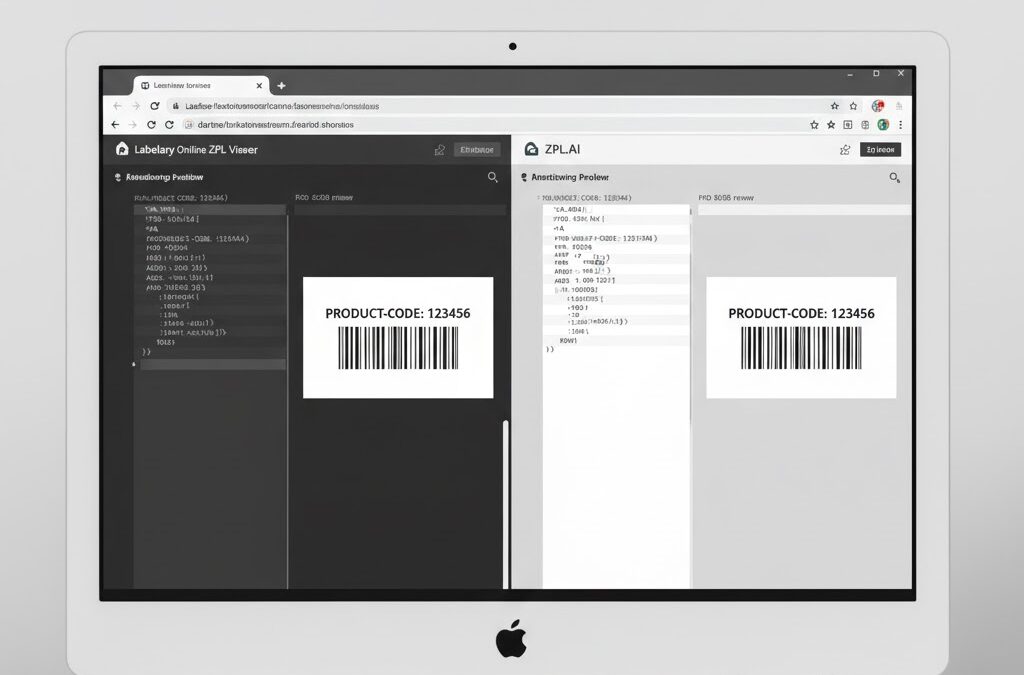
If you work with Zebra printers or handle shipping label automation, chances are you’ve come across Labelary, one of the first online ZPL viewers ever built. It’s been around for years — reliable, lightweight, and simple.
But the ZPL landscape has changed.
What used to be a niche developer tool has evolved into an ecosystem where speed, accuracy, and real-time collaboration matter more than ever. That’s where ZPL.ai steps in.
In this article, we’ll break down the key differences between Labelary and ZPL.ai, compare their features, and help you decide which platform makes sense for your workflow in 2025.
Overview: What Each Platform Does
| Feature | Labelary | ZPL.ai |
| Type | Web-based API & viewer | Full SaaS platform with viewer + editor |
| Interface | Minimal, technical | Intuitive, modern UI |
| Speed | Good for small renders | Optimized for large files |
| API Access | Yes, basic REST API | Yes, scalable cloud API |
| Team Features | None | Multi-user collaboration |
| Label Preview | Static | Real-time rendering with DPI options |
Labelary is ideal for quick checks and developers comfortable with raw code.
ZPL.ai, on the other hand, was built for both developers and businesses who need reliability, scalability, and a smoother experience — including integrated cloud storage and instant label previews.
Ease of Use and Interface
Labelary’s interface has remained nearly the same for the past decade — a single text box and a “Render” button. It works, but it’s not built for today’s collaborative environments.
ZPL.ai introduces a more visual, workspace-oriented design:
- Drag-and-drop label uploads.
- Real-time rendering updates.
- Zoom and grid controls for precision.
- Saved projects and label versioning.
For non-technical teams or designers who want to validate layouts before sending them to production, that difference is enormous.

Rendering Speed and Accuracy
This is where ZPL.ai truly shines.
It uses an optimized rendering engine that processes large ZPL files up to 5x faster than Labelary, especially when handling multi-label batches.
For developers working with 300 or 600 DPI labels, speed matters. You don’t want to wait 10 seconds to confirm whether a barcode aligns properly — ZPL.ai renders it instantly.
Moreover, ZPL.ai supports advanced printer emulation, meaning what you see on screen is exactly what you’ll get when you print, no surprises.
Collaboration and API Capabilities
Labelary’s API is reliable but basic. It lets you send a POST request with ZPL code and get a PNG image in response.
ZPL.ai takes this concept much further:
- Scalable API with authentication keys.
- Automatic format detection (PDF, PNG, ZPL).
- Error reporting and validation logs.
- Multi-user API dashboards for monitoring requests.
For teams managing large-scale print automation — like e-commerce, logistics, or healthcare labeling — these features translate into real operational control.
Cloud and Integration
One major limitation of Labelary is that it’s not cloud-connected — you can’t save, share, or organize your labels online. Every time you use it, you start from scratch.
ZPL.ai introduces cloud project management:
- Save templates to your account.
- Access from any browser or device.
- Invite teammates to edit labels collaboratively.
It also integrates with tools like Make, Zapier, and custom ERP systems for fully automated workflows.
Developer Ecosystem and Support
Labelary has a loyal developer base, but it’s largely self-supported — no dashboard, no documentation updates, and no customer service team.
In contrast, ZPL.ai provides:
- Active customer support.
- Detailed documentation and tutorials.
- Regular feature updates and security patches.
- A growing community forum for developers.
For companies where uptime and support SLAs matter, this difference can be decisive.
Pricing and Value
Labelary remains free to use, but limited in scalability.
ZPL.ai follows a freemium model — you can test it for free, then upgrade for API volume, storage, and collaboration tools.
When comparing cost to capability, ZPL.ai clearly targets professional and enterprise use, while Labelary remains better suited for one-off or hobbyist projects.
Verdict: Which One Should You Choose?
If you only need a quick, single-use label renderer, Labelary is perfectly fine.
It’s simple, effective, and has served the developer community well for years.
But if you need something built for 2025’s workflows — with real-time rendering, multi-user access, integrations, and continuous updates — ZPL.ai is the logical next step.
It’s faster, more precise, and designed for teams that treat labeling as part of their digital infrastructure, not a side task.
Before switching, you can even test your current ZPL code for accuracy using the online zpl viewer. It’s the easiest way to see how your labels will actually print before going live.